Website Redesign vs. New Website: Which Does Your Business Need?
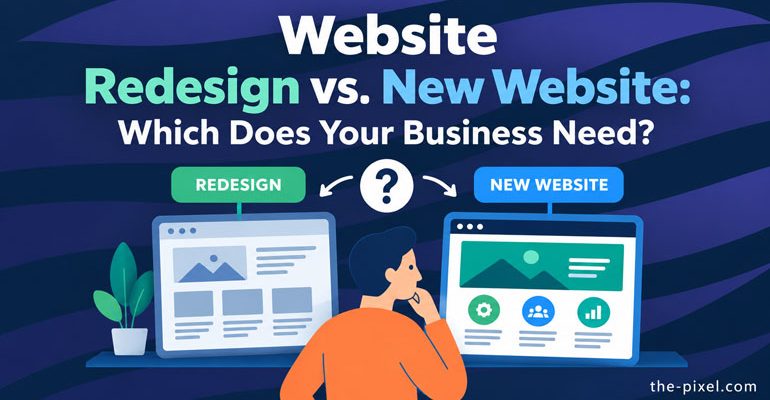
Website Redesign vs. New Website: Which Does Your Business Need?
Your business website isn’t performing the way you expected. Maybe it’s not generating enough leads, the design feels outdated, or customers are having difficulty finding the information they need.
So, does that mean it’s time to build an entirely new website?
Not necessarily.
Many businesses assume that improving their online presence means starting over. However, an existing website may already have a solid foundation worth keeping.
Sometimes the problem isn’t the website itself. It’s how the content is organized, how visitors navigate between pages, or how effectively the design communicates what the business offers.
In other situations, outdated technology, structural limitations, or changing business requirements make rebuilding the website a more practical long-term solution.
Understanding the difference can help your business make an informed investment without replacing something that may already be working.
Start With Research, Not a Redesign
Before deciding whether your business needs a website redesign or a completely new website, it’s important to understand how your current website is performing.
A website should do more than establish an online presence. It should help potential customers discover your business, understand your services, and confidently take the next step.
That requires understanding both how visitors find your website and what happens after they arrive.
Understanding Website Performance Through Analytics
Tools like Google Analytics 4 (GA4) and Google Search Console provide valuable insights into website performance.
Google Analytics helps identify how visitors interact with your website, including which pages receive traffic, how users navigate between pages, and whether important actions are being completed.
Google Search Console provides insight into your website’s visibility in Google Search, including search queries, impressions, clicks, and average search positions.
Together, these tools can help answer important questions:
-
Which pages attract the most visitors?
-
What search terms are bringing potential customers to your website?
-
Are visitors finding your most important services?
-
Where do visitors leave before completing an important action?
-
Which pages are generating inquiries or other conversions?
For example, a business might discover that its website receives consistent organic traffic but generates very few contact form submissions.
That doesn’t automatically mean the website needs to be rebuilt.
The issue could be unclear calls to action, confusing navigation, insufficient service information, or a contact process that creates unnecessary friction.
Understanding the underlying problem helps prevent businesses from investing in changes that may not address the actual issue.
Understanding Visitor Behavior Through Qualitative Research
While quantitative analytics reveal patterns in website performance, qualitative research helps explain why visitors may be experiencing difficulties.
Behavior analytics tools such as Hotjar can provide additional insight through session recordings, heatmaps, and visitor feedback.
These tools help reveal how people interact with a website beyond traditional traffic reports.
For example, session recordings may show visitors repeatedly navigating between service pages because they cannot find specific information.
Heatmaps may reveal that important calls to action receive little attention or that visitors rarely scroll far enough to see essential content.
These observations can help identify opportunities to improve the user experience.
However, behavioral data should be interpreted carefully. A recording may show where someone struggled, but it doesn’t always explain their intentions. Additional research, usability testing, or customer feedback may be needed to understand the underlying cause.
By combining qualitative and quantitative research, businesses gain a more complete understanding of their website’s strengths and weaknesses.
Evaluating the Website Through a UX Audit
Once the initial research and discovery findings have been gathered, the next step is evaluating the website’s overall user experience.
A UX audit examines how effectively the website supports both business objectives and visitor needs.
Rather than focusing exclusively on visual appearance, the evaluation considers several important areas.
Website Navigation and Information Architecture
Can visitors easily find the information they’re looking for?
A website may contain valuable content, but poorly organized navigation can make that information difficult to discover.
Reviewing the website’s information architecture helps identify opportunities to simplify navigation, improve content relationships, and create clearer paths between pages.
User Journey and Conversion Opportunities
Does the website guide visitors toward meaningful actions?
Whether the goal is requesting a quote, scheduling a consultation, or contacting a business, visitors should understand what to do next.
A UX audit evaluates how effectively the website supports those decisions and identifies unnecessary obstacles.
Visual Design and Brand Consistency
Does the website communicate a consistent and professional brand experience?
Inconsistent typography, colors, layouts, and messaging can make a website feel disconnected.
Improving visual consistency helps create a more cohesive experience and reinforces the business’s identity.
Accessibility and Mobile Usability
Can visitors comfortably use the website across different devices and abilities?
Accessibility, responsive layouts, readable content, and clear interactive elements are essential considerations.
A website that works well on a desktop computer may still create significant challenges for mobile users or people using assistive technologies.
Website Performance and Technical Foundation
Is the website reliable, maintainable, and capable of supporting future improvements?
Technical considerations include loading performance, platform limitations, security, software updates, and the ability to introduce new functionality.
These findings are especially important when deciding whether to redesign an existing website or rebuild it.
What Does Your Website Actually Need?
After completing the research and UX audit, we have a clearer understanding of what’s working, what’s creating challenges, and where improvements could have the greatest impact.
Not every issue requires rebuilding an entire website.
If the existing platform is reliable and the website’s structure supports your business goals, improving the navigation, content, visual design, and user experience may be enough.
However, if the website relies on outdated technology, has significant performance limitations, or can no longer support your business needs, building a new website may be the more practical long-term solution.
The goal isn’t simply to create something new. It’s to make informed decisions that improve your website’s performance while protecting the value of what already works.
When a Website Redesign Makes Sense
A website redesign focuses on improving an existing website rather than replacing its entire technical foundation.
This approach may be appropriate when the website’s platform remains functional, but the overall experience no longer meets business or customer expectations.
Common reasons to consider a redesign include:
-
Outdated visual design: The website no longer reflects the company’s current brand or professional image.
-
Confusing navigation: Visitors struggle to locate services, company information, or important resources.
-
Inconsistent branding: Colors, typography, imagery, and messaging vary throughout the website.
-
Poor mobile experience: Existing layouts are difficult to navigate on smartphones or tablets.
-
Low conversion rates: Visitors reach the website but rarely complete important actions.
-
Disorganized content: Information exists but needs to be restructured to better support the customer journey.
For example, a manufacturing company may have an established website with valuable product information, strong search visibility, and a reliable content management system.
However, customers may struggle to locate products, understand available services, or contact the appropriate department.
In this situation, improving the information architecture, navigation, page layouts, and conversion paths may deliver meaningful improvements without replacing the underlying platform.
A redesign can also preserve existing content and search visibility when changes are carefully planned.
However, retaining the platform doesn’t eliminate the need for SEO planning. Changes to page content, navigation, internal links, or URLs can still affect search performance.
When It’s Time to Build a New Website
Sometimes a website’s existing foundation creates more limitations than opportunities.
In these situations, continuing to modify the current website may introduce additional complexity, maintenance challenges, and long-term expenses.
A complete rebuild may be appropriate when:
-
The technology is outdated: The website relies on unsupported software, obsolete frameworks, or plugins that create security and compatibility concerns.
-
The platform limits growth: The business needs functionality that cannot be implemented effectively within its current system.
-
Maintenance has become difficult: Routine updates require excessive development work or repeatedly introduce problems.
-
The website structure is fundamentally flawed: Existing templates, content relationships, or technical constraints prevent meaningful improvements.
-
Business requirements have changed: The company has expanded its services, entered new markets, or significantly changed how it operates.
-
Performance problems are difficult to resolve: The existing architecture prevents the website from meeting reasonable performance expectations.
For example, a business may have a website built on a heavily customized platform that is no longer supported.
Even if the visual design could be improved, the technical limitations may continue creating problems.
In this situation, rebuilding the website on a modern, maintainable platform may provide greater long-term value.
A new website also creates an opportunity to reconsider the content structure, navigation, user journeys, and technical architecture together.
However, rebuilding should not mean discarding everything.
Existing content, successful user journeys, valuable search rankings, and established brand elements should be evaluated before making significant changes.
Website Redesign vs. New Website: Understanding the Differences
Although both approaches aim to improve the digital experience, the scope and technical requirements can differ significantly.
| Consideration | Website Redesign | New Website |
|---|---|---|
| Primary objective | Improve the existing website experience | Establish a new website foundation |
| Existing platform | Typically retained | May be replaced |
| Visual design | Updated or redesigned | Developed as part of the new website |
| Content | Reviewed, improved, or reorganized | May require substantial restructuring |
| Navigation | Improved within existing capabilities | Can be redesigned around new requirements |
| Technical architecture | Primarily retained | Reconsidered or rebuilt |
| SEO considerations | Protect and improve existing visibility | Requires careful planning and potentially migration |
| Project scope | Depends on required improvements | Depends on technical and business requirements |
| Long-term flexibility | Depends on the existing platform | Depends on the selected architecture |
Explore ThePixel’s website design and redesign services.
Neither option is automatically less expensive or more effective.
A complex redesign involving extensive content restructuring, custom functionality, and UX improvements can require substantial effort.
Likewise, a new website built around straightforward business requirements may be relatively simple.
The appropriate investment depends on the business’s goals, existing technology, content requirements, and the problems being addressed.
What About Your Existing SEO Rankings?
One of the most important considerations when redesigning or rebuilding a website is protecting its existing search visibility.
Your website may have spent years establishing rankings for important search terms.
Certain pages may consistently attract visitors looking for your services, products, or business information.
Replacing those pages without understanding their performance can put valuable organic traffic at risk.
Before making significant changes, it’s important to identify:
-
Pages generating organic search traffic.
-
Search queries associated with important services.
-
Existing URLs with established search visibility.
-
Internal links connecting related content.
-
Pages receiving valuable external backlinks.
-
Content that continues to support business goals.
When URLs must change, appropriate redirects and a carefully planned migration can help search engines understand where content has moved.
However, redirects alone do not guarantee that rankings will remain unchanged.
A successful redesign or rebuild should consider SEO throughout the project rather than treating it as something to address after launch.
The objective is to improve the website without unnecessarily sacrificing the search visibility it has already established.
How Much Should Your Business Invest?
Website costs depend on the scope of work required to achieve the desired results.
Before establishing a project budget, businesses should understand which problems need to be addressed and which improvements are most important.
For example, a website with a reliable platform and established content may benefit from focused UX improvements, updated branding, and better conversion paths.
Another business may require a complete technical rebuild, content migration, new functionality, and extensive design work.
These projects involve different levels of complexity.
Rather than choosing an approach based entirely on the lowest initial cost, businesses should consider long-term maintenance, flexibility, performance, and future growth.
An inexpensive solution that fails to address the underlying problems may lead to additional expenses later.
Likewise, investing in an entirely new website when targeted improvements would achieve the same goals may not be the best use of the budget.
A clear understanding of the project requirements helps establish realistic expectations before development begins.
Five Questions to Ask Before Making Your Decision
If you’re unsure whether your business needs a redesign or a new website, start by answering these questions.
1. What isn’t working with your current website?
Identify specific problems rather than assuming the entire website needs to be replaced.
Are visitors struggling with navigation? Is the website failing to generate inquiries? Does the design no longer reflect your brand?
2. Is your existing website platform still reliable?
Consider whether the platform receives regular updates, supports your business requirements, and can be maintained without unnecessary complexity.
3. What does your website analytics data reveal?
Review organic search performance, visitor behavior, important landing pages, and conversion activity.
Look for patterns that help distinguish between visibility problems and usability challenges.
4. Has your business significantly changed?
New services, expanded markets, changing customer expectations, or different operational requirements may justify a broader website strategy.
5. What are your long-term business goals?
Consider what the website needs to accomplish over the next several years.
The right decision should support future business needs rather than simply address the website’s current appearance.
Making the Right Website Decision Starts With Understanding the Problem
A website redesign and a completely new website can both improve your business’s online presence.
The important question isn’t which option sounds more impressive.
It’s which approach addresses the problems preventing your website from supporting your business goals.
Research, analytics, UX evaluation, and technical discovery provide the information needed to make that decision.
Sometimes targeted improvements are enough to create a more effective website.
Other times, rebuilding provides the flexibility and technical foundation needed for long-term growth.
The right solution begins with understanding what already works, identifying what needs to change, and investing in improvements that create meaningful value for your business.
Not Sure Whether Your Website Needs a Redesign or a Rebuild?
At ThePixel, we approach website projects by understanding your business goals, evaluating your existing website, and identifying opportunities to improve the digital experience.
Whether your website needs targeted UX improvements, a comprehensive redesign, or a completely new foundation, the goal is to recommend an approach that supports your business rather than introduce unnecessary complexity.
Let’s discuss your website and determine the right next step
Since 2008, ThePixel has helped businesses build and improve their online presence through strategic website design and development. Our experience has taught us that a successful website requires more than an attractive design. It takes thoughtful planning, intuitive user experiences, and a clear understanding of your business goals.
Whether you’re considering a website redesign or starting from scratch, we’ll help you determine the right approach to improve visibility, engage visitors, and turn opportunities into customers.
Ready to take the next step?
Contact ThePixel to discuss your project. We’ll walk you through our website design process, answer your questions, and explore your goals during a phone or Zoom consultation.