SEO Mistakes to Avoid

SEO Mistakes to Avoid
Common SEO mistakes to avoid
Keeping up with Search Engine Optimization (SEO) isn’t always straightforward—especially if it’s only one part of your role. Many businesses handle marketing in-house, find an approach that works, and continue using it without revisiting their strategy.
The problem is that search engines are constantly evolving. What worked before may not deliver the same results today. Businesses that maintain strong visibility are the ones that continuously refine their approach, improve their content, and adapt to how users search and interact online.
Avoiding common SEO mistakes can make a significant difference in how your website performs, how easily customers find you, and how effectively your site converts traffic into leads.
1. Not understanding what your customers are searching for
One of the most common mistakes is focusing too much on what you want to say, rather than what your audience is actually looking for.
SEO today is driven by intent. Your content should align with the questions, needs, and problems your customers are trying to solve.
If your messaging doesn’t match what users are searching for, your content won’t perform—no matter how well it’s written.
How to improve:
- Identify common questions your customers ask
- Focus on real problems your services solve
- Align keywords with user intent, not just industry terms
- Create content that guides users toward a solution
When your website reflects your customer’s perspective, it becomes easier to attract the right traffic and convert visitors into leads.
2. Prioritizing keywords over quality content
There was a time when SEO meant repeating keywords as often as possible. That approach no longer works—and can actually hurt your performance.
Search engines now prioritize content that is clear, helpful, and relevant. If your content feels forced, repetitive, or difficult to read, users will leave—and search engines take that as a signal.
Your content should be written for people first, with keywords supporting the message—not dominating it.
Best practices for content:
- Write naturally and clearly
- Focus on providing real value
- Use keywords where they make sense
- Avoid overloading content with repeated phrases
- Structure content so it’s easy to scan and read
Strong content builds trust, improves engagement, and supports long-term SEO performance.
3. Ignoring mobile experience and site performance
A website that doesn’t perform well on mobile devices creates immediate friction for users. If your site is slow, difficult to navigate, or hard to read, visitors won’t stay long.
Mobile experience is no longer optional—it’s a core part of how your website is evaluated and how users interact with your brand.
A fast, responsive, and easy-to-use website improves both user experience and search visibility.
What to focus on:
- Fast loading speeds
- Clean, responsive layouts
- Easy-to-use navigation
- Readable text and accessible content
- Optimized images and media
If your website isn’t built to perform across all devices, it will limit both your reach and your results.
4. Targeting keywords that are too broad
Trying to rank for broad, highly competitive keywords can make it difficult to gain traction—especially for smaller or growing businesses.
A more effective approach is to focus on what makes your business unique and build your SEO strategy around that.
Specific, targeted keywords often lead to better results because they attract users who are looking for exactly what you offer.
How to approach keyword strategy:
- Focus on niche or service-specific terms
- Include location-based keywords where relevant
- Target long-tail keyword phrases
- Build content around specific use cases or services
By narrowing your focus, you can attract more qualified traffic and improve your chances of converting visitors into leads.
5. Using duplicate or repetitive content
Duplicate content is a common issue that can weaken your SEO performance. When multiple pages contain similar or identical content, it becomes harder for search engines to determine which page should rank.
It also creates a poor user experience, especially if visitors encounter the same information across multiple pages.
Your content should be original, purposeful, and tailored to each page.
To avoid duplicate content issues:
- Create unique content for every page
- Avoid repeating the same keyword-heavy copy across multiple pages
- Ensure each page serves a distinct purpose
- Use canonical links when necessary
- Link back to original sources when republishing content
Clear, unique content helps search engines understand your website and improves overall performance.
Auditing your SEO strategy
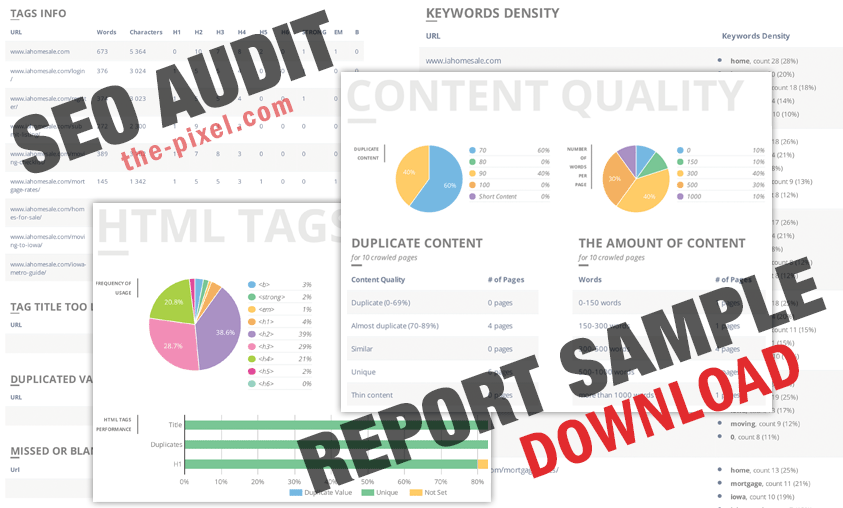
SEO isn’t a one-time effort—it’s an ongoing process. Regularly reviewing your website helps you identify issues, uncover opportunities, and stay aligned with current best practices.
What to review during an audit:
- Content quality and relevance
- Conversion optimization with keyword alignment
- Page performance and speed
- Mobile usability
- Technical SEO issues
- Conversion paths and user experience
Staying proactive with your SEO ensures your website continues to support your business goals.
Final thought
SEO success doesn’t come from shortcuts—it comes from clarity, consistency, and a focus on the user experience.
By avoiding these common mistakes and continuously improving your approach, you can build a stronger online presence, attract the right audience, and turn more visitors into leads.
At ThePixel, we focus on creating SEO-driven websites that are built to perform—combining strategy, UX, and content to help businesses grow.
Hire ThePixel to build your next website!
Since our founding in 2008, we’ve created and launched many types of business websites. Over the last decade and we’ve learned a thing or two! That’s why we’re masters of our craft, let us help you build the website of your dreams – one that generates traffic, leads and conversions.
Are you ready to start? If yes, contact ThePixel and one of our representatives will guide you through the website phases and how the process works either by a Zoom Meeting or phone.