Why is the Bounce Rate so High on Your Landing Page?

Why is the Bounce Rate so High on Your Landing Page?
The Bounce Rate is the Death March
Modern websites are expected to perform at a much higher level than they did just a few years ago. Businesses are no longer competing only on design. They are competing on speed, usability, visibility, trust, content quality, mobile experience, and overall digital performance.
Today’s users expect instant clarity the moment they arrive on a website or landing page. They want to immediately understand what a business offers, whether the company feels credible, how quickly they can find information, and how easy the experience feels across every device.
At the same time, search behavior is evolving rapidly. AI-powered search, conversational search experiences, personalized recommendations, voice search, and mobile-first browsing are changing how users discover and evaluate businesses online.
This means a high bounce rate is no longer simply a marketing metric. It is often one of the clearest indicators that the user experience is disconnected from modern expectations.
When visitors leave quickly, it usually means friction exists somewhere within the experience.
That friction may involve:
- Messaging
- Website performance
- Mobile usability
- Content relevance
- User flow
- Search intent
- Trust signals
- Conversion structure
Reducing bounce rates requires more than cosmetic design changes. It requires a connected strategy focused on user behavior, SEO, UX, analytics, content, and performance optimization working together.
What a High Bounce Rate Actually Means
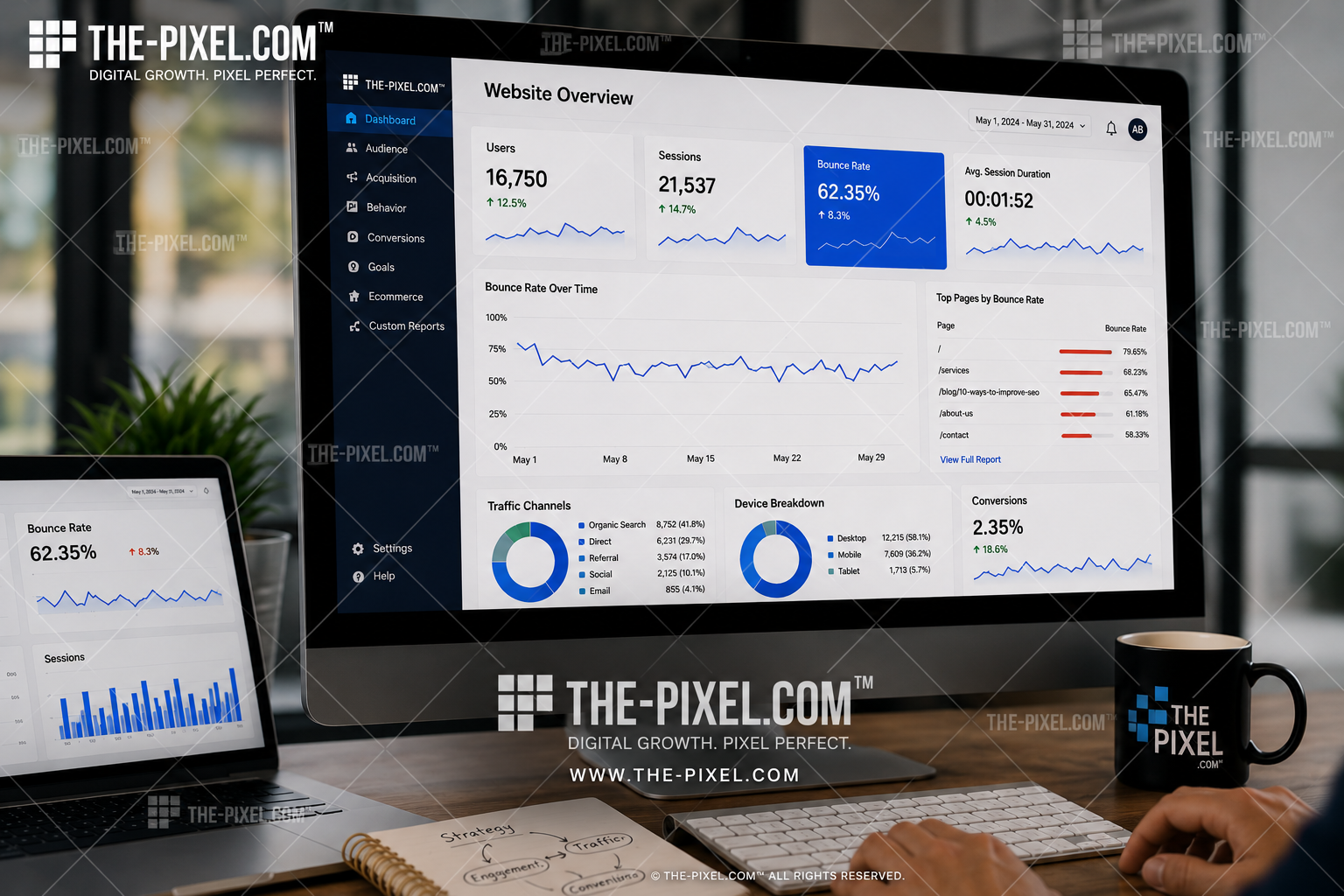
A bounce rate measures the percentage of users who leave a website or landing page without taking another meaningful action. This could include leaving without navigating to another page, clicking a call to action, submitting a form, or interacting with content.
While bounce rates naturally vary by industry and traffic source, consistently high bounce rates often indicate that users are not finding what they expected after arriving on the website.
Modern analytics platforms now provide much deeper visibility into user behavior than traditional bounce rate metrics alone. Businesses can now analyze:
- Scroll depth
- Heatmaps
- Session recordings
- Click patterns
- Device behavior
- Traffic quality
- User engagement flow
- Conversion behavior
These insights help identify exactly where users encounter friction or lose interest.
In many cases, a high bounce rate is not caused by a single issue. Multiple small friction points often combine to create a frustrating user experience.
1. Users Cannot Immediately Understand What Your Business Does
The first few seconds of a website visit are critical.
Modern users scan content extremely quickly. If the messaging is unclear, generic, cluttered, or overly complicated, visitors often leave before exploring deeper content.
Many businesses accidentally assume users already understand their services, industry terminology, or value proposition. In reality, most visitors arrive with limited context and short attention spans.
Your website or landing page should immediately answer:
- What does this business do?
- Who is this service for?
- Why should I trust this company?
- What makes this different?
- What should I do next?
Users should never have to “figure out” the purpose of the website.
Strong messaging creates clarity through:
- Clear headlines
- Concise supporting content
- Strong visual hierarchy
- Readable layouts
- Strategic spacing
- Intentional calls to action
Modern UX design focuses heavily on reducing cognitive load. The easier the content is to understand, the more likely users are to continue engaging.
Common problems include:
- Vague headlines
- Too much jargon
- Generic marketing language
- Weak value propositions
- Poor hierarchy
- Overwhelming layouts
The goal is to communicate value instantly without forcing users to work for the information.
2. Your Website Loads Too Slowly
Website performance now plays a major role in both user experience and SEO visibility.
Users expect websites and landing pages to load almost instantly. Delays create frustration immediately, especially on mobile devices where users are often multitasking or browsing quickly.
Even a visually impressive website can struggle if performance issues interrupt the experience.
Modern performance problems often include:
- Large image files
- Unoptimized video backgrounds
- Heavy JavaScript frameworks
- Excessive animations
- Poor hosting infrastructure
- Too many plugins
- Third-party tracking scripts
- Unoptimized fonts
- Poor caching strategies
Slow websites negatively affect:
- Search rankings
- Mobile usability
- User trust
- Engagement rates
- Lead generation
- Conversion performance
Google’s Core Web Vitals now place major emphasis on real-world user experience metrics including loading speed, layout stability, and interaction responsiveness.
Modern websites need to balance visual design with technical efficiency.
Performance optimization is no longer just a developer concern. It directly impacts business growth, visibility, and user retention.
3. The Mobile Experience Feels Frustrating
Most website traffic now comes from mobile devices.
Users expect fast, smooth, intuitive experiences regardless of screen size. If the mobile experience feels cluttered, difficult, slow, or confusing, users often leave immediately.
Many businesses still prioritize desktop layouts while treating mobile as a secondary experience. Modern UX strategy works in the opposite direction by designing mobile-first experiences from the beginning.
Mobile users interact differently than desktop users. They are often:
- Scrolling quickly
- Multitasking
- Using one hand
- Researching on the go
- Looking for fast answers
This means the experience must feel effortless.
Strong mobile usability includes:
- Readable typography
- Simplified navigation
- Fast-loading sections
- Thumb-friendly interactions
- Clear buttons
- Reduced clutter
- Prioritized content hierarchy
Small usability frustrations become amplified on mobile devices.
Issues like tiny buttons, long forms, excessive popups, difficult navigation, or crowded layouts can significantly increase bounce rates.
Mobile experience also directly affects SEO rankings because Google prioritizes mobile-first indexing.
4. Your Traffic Does Not Match User Intent
One of the biggest causes of high bounce rates is attracting the wrong audience.
Businesses often focus heavily on generating more traffic without evaluating whether that traffic is actually aligned with their services or goals.
Modern SEO is no longer about simply ranking for keywords. Search engines increasingly prioritize intent matching and user satisfaction.
If users click on your website expecting one thing but encounter something different, they often leave immediately.
Traffic mismatches commonly come from:
- Broad keyword targeting
- Misleading headlines
- Weak SEO strategy
- Poor ad targeting
- Generic AI-generated content
- Clickbait-style content
- Irrelevant social campaigns
Modern search algorithms analyze far more than keywords alone. They evaluate:
- Relevance
- User satisfaction
- Engagement
- Content usefulness
- Expertise
- Authority
- Experience signals
The goal is not simply attracting visitors. The goal is attracting qualified users who are genuinely interested in your services.
A highly targeted audience with stronger engagement is far more valuable than large amounts of unqualified traffic.
5. Your Website Feels Outdated
Users form trust opinions almost immediately after arriving on a website.
An outdated website can reduce credibility within seconds, even if the business itself provides excellent services.
Modern users associate digital quality with business quality. If the website feels neglected, cluttered, slow, or visually inconsistent, users may assume the company itself operates similarly.
Outdated experiences often include:
- Old design styles
- Poor typography
- Weak imagery
- Inconsistent branding
- Cluttered layouts
- Broken spacing
- Low-quality visuals
- Overwhelming content sections
Modern web design focuses heavily on:
- Simplicity
- Structure
- Readability
- Whitespace
- Clean visual hierarchy
- Intentional layouts
- Consistent branding
Trust signals matter more than ever online.
6. Your Content Is Too Generic
The internet is flooded with repetitive content.
AI tools have made content production easier, but they have also increased the amount of low-quality, generic, and repetitive information online.
Users now recognize shallow content quickly.
Search engines are also becoming better at identifying content that lacks expertise, originality, usefulness, or genuine value.
Modern content strategy should focus on creating content that feels:
- Helpful
- Clear
- Authentic
- Insightful
- Structured
- Relevant
- Experience-driven
Strong content builds trust by demonstrating expertise and solving real user problems.
Businesses should focus on:
- Real examples
- Industry knowledge
- Helpful explanations
- Clear formatting
- Readability
- User intent
- Educational value
This is especially important for service pages and landing pages competing in crowded markets where users are comparing multiple businesses at once.
7. The Website Creates Too Much Cognitive Overload
Too much information can overwhelm users.
Many websites attempt to show every service, every feature, every testimonial, and every call to action at once. This often creates confusion rather than clarity.
Modern UX strategy focuses on simplifying decision-making.
Users should feel guided through the experience rather than overloaded by it.
Cognitive overload commonly comes from:
- Too many menu options
- Excessive text
- Cluttered layouts
- Competing calls to action
- Popups
- Poor hierarchy
- Inconsistent design patterns
Good UX creates clarity through:
- Focused content flow
- Predictable navigation
- Strategic spacing
- Clear hierarchy
- Visual consistency
- Intentional structure
The easier the experience feels mentally, the longer users tend to stay engaged.
8. Weak Calls to Action Reduce Engagement
Even strong websites can struggle if users are unsure what to do next.
Calls to action play a major role in guiding users through the experience and encouraging deeper engagement.
Modern users expect clear direction.
Every major section of a website or landing page should help move users toward a meaningful next step.
Effective calls to action are:
- Clear
- Action-oriented
- Easy to identify
- Relevant to user intent
- Strategically positioned
Examples include:
- Schedule a consultation
- Request a quote
- Explore services
- View portfolio work
- Contact the team
- Start a project
Weak or inconsistent calls to action create uncertainty, which often causes users to leave instead of continuing the experience.
9. Poor UX and Accessibility Create Friction
Accessibility and usability are essential parts of modern website strategy.
Websites should be designed for real users with different devices, screen sizes, behaviors, and accessibility needs.
If users struggle to navigate content, read text, interact with forms, or understand layouts, bounce rates increase quickly.
Modern UX best practices focus on:
- Accessibility compliance
- Clear typography
- Strong color contrast
- Responsive layouts
- Keyboard-friendly navigation
- Simplified interactions
- Consistent design systems
Accessibility improvements often benefit all users, not just users requiring accommodations.
Good UX removes friction and helps users move through the experience naturally.
10. Your Website Is Not Built as a Connected Digital Ecosystem
Modern websites are deeply connected to SEO, analytics, automation, content strategy, AI-supported optimization, CRM systems, and conversion tracking.
High-performing businesses no longer treat the website as a standalone marketing asset.
Instead, the website functions as the central hub supporting visibility, engagement, trust, lead generation, and long-term growth.
Today’s most effective websites and landing pages are built around:
- UX strategy
- SEO structure
- Analytics insights
- Mobile-first usability
- Performance optimization
- Conversion-focused design
- AI-supported research
- Content strategy
- User behavior analysis
The businesses adapting fastest to modern search behavior are creating connected digital ecosystems designed around the full customer journey.
Reducing Bounce Rates Requires a Full Experience Strategy
Reducing bounce rates is rarely solved by changing a single button color or headline.
Modern optimization requires understanding how users think, search, navigate, and interact across the entire digital experience.
Effective optimization strategies focus on:
- User intent
- Traffic quality
- Website speed
- Mobile usability
- Content relevance
- UX clarity
- Conversion flow
- Search visibility
- Trust building
The goal is not simply keeping users on the website longer.
The goal is creating a faster, clearer, more useful experience that helps users confidently move forward.
That is where UX strategy, SEO, analytics, content optimization, and AI-supported research begin working together to improve engagement, conversions, and long-term business growth.
Hire ThePixel to build your next website!
Since our founding in 2008, we’ve created and launched many types of business websites. Over the last decade and we’ve learned a thing or two! That’s why we’re masters of our craft, let us help you build the website of your dreams – one that generates traffic, leads and conversions.
Are you ready to start? If yes, contact ThePixel and one of our representatives will guide you through the website phases and how the process works either by a Zoom Meeting or phone.